Friday, 14 February 2014

'A dateless lively heat': Happy Valentine's!

In keeping with today's theme of love, all things heart-shaped and amorous, I thought it might be fun to share a few early-modern (and, I admit, some eighteenth- and nineteenth-century ones) that reflect today's warm and fuzzy feeling. (And if that warm, fuzzy feeling is only provided by your furry slippers this year, then that's fine, too!)

All of the images are courtesy of Wellcome Images.

Cupid dissecting a heart (1665)
The treatment of a love-sick woman (representing the Netherlands) (1672)
Cupid armed with a bow and arrow flies through the window (18th century)

A woman with bulging eyes, expressing desire through her face (1770)

A woman, the physiognomy of whom expresses attention excited by desire (1792)

A bewildered doctor taking the pulse of a love-sick woman (1802)

A young woman in love clasps her hands against her heart (1830)
There will be another post coming up over the weekend on some 'Bellifying Receipts', so keep your eyes peeled!

© Jenna Townend 2014

Thursday, 30 January 2014

Overton Poetry Prize at Loughborough University

Hi everyone,

Please feel free to circulate this information to anyone who you think might be interested in this competition, or indeed to any organisations you know of you would be happy to pass it on to their members.

The Department of English and Drama at Loughborough University has set up the Overton Poetry Prize in memory of our Professor Bill Overton who passed away in 2012. The prize is for a sequence of poems on any subject up to 300 lines. 

First prize is the publication of the sequence in chapbook form, with two runners-up prizes of £50 each. 

Amongst the judges is Sarah Jackson, who won the Seamus Heaney Prize in 2013.

The entry fee is £10 per submission and the competition closes on 31st March. 


Much of Bill’s teaching and writing was on poetry, and the proceeds from this competition will fund an early-career poet in residence here at the University.

For all of the additional information on this exciting prize, just go to: http://www.lboro.ac.uk/departments/english-drama/events/poetry-prize/

I'm sure you will all agree that this is a fantastic opportunity for any budding writer, and I and the rest of Loughborough's English and Drama Department would be immensely grateful if you could help spread the word!

Thank you!

Jenna


Monday, 20 January 2014

Wellcome Images

As I'm sure most of you will have already heard today, all of the Wellcome images previously out of copyright have now been made freely available! Hurrah! Head over to wellcomeimages.org to have a browse, if you haven't already done so.

Given this wonderful news, I thought I would share a few of my favourite images that I've found as I have been having a browse through the hundreds of thousands that are available this afternoon.

'Wound man', 15th century
'Game of Heaven and Hell' - late 18th century (or, Snakes and Ladders!)
'The Massacre of Hugenots at Tours'
'A chiropodist treating a patient's foot'
'A Travelling Medicine Vendor', 1635
'Anatomical Illustration of a Pregnant Woman', 1634
'A Deformed Face', 1632
All images are taken from Wellcome Images.

© Jenna Townend 2014

Saturday, 18 January 2014

Hannah Woolley's homemade spirits

My blog has been rather neglected over the last couple of months. Sadly, the pressures of MA life have just meant that it has had to sit gathering dust for a little while. However, that is about to change! I have a couple of weeks off before my second semester starts, so I'm looking forward to getting lots of blogging done from the comfort of my sofa!

I thought I'd kick things off today with a topic that has probably been quite close to the hearts (or livers) of all Loughborough English and Drama students and staff in recent days: alcohol. The former, due to celebratory antics as coursework deadlines pass, and the latter, as an aid to all the marking we have inflicted on them!

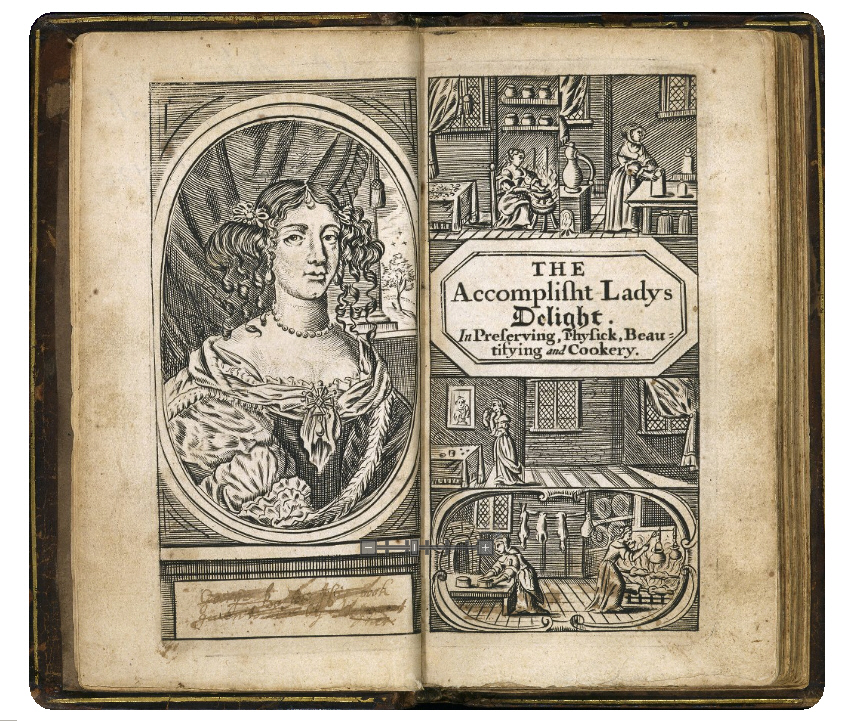
Now, we're all quite used to popping down to the supermarket to pick up a bottle of wine for a Friday or Saturday night, and having a dazzling array of price ranges to choose from. But what options were available for our seventeenth-century ancestors? Hannah Woolley has some ingenious homemade suggestions in The Accomplish'd Lady's Delight.

To Make Artificial Claret:

Take six gallons of water, two gallons of the best Syder, put thereto eight pound of the best Malaga raisins bruised in a Morter, let them stand close covered in a warm place the space of a fortnight, every two days stirring them well together; then press out the Raisins and put the liquor into the sid Vessel again, to which add a quart of the juice of Ras-berries, and a pint of the juice of black Cherries; cover this liquor with bread spread thick with strong Mustard, the Mustardseed being downward, and so let it work by the fire side three or four days, then turn it up and let it stand a week, and then bottle it up, and it will tast as quick as bottle Beer and become a very pleasant drink, and indeed far better and wholsomer then our common Claret (pp. 38-39).


To Make Black-Cherry Wine:


Take a Gallon of the juice of Black-Cherries, keep it in a Vessel close stopped, till it begin to work, then filter it, and an Ounce of Sugar being added to every Pint, and a Gallon of White-Wine, and so keep it close stopped for Use (pp. 81-82).


'To Make Syder:


Take a Peck of Apples and slice them, and boyl them in a Barrel of Water, till the third part be wasted; then cool your water as you do for Wort, and when it is cold, you must pour the water upon three Measures of grown Apples. Then draw sorth the Water at a Tap three or four times a day, for three days together. Then press out the Liquor, and Tun it up; when it hath done working, stop it up close (p. 90). 


Unfortunately, Woolley offers no information on alcohol percentages, so it's perhaps best to air on the side of caution when attempting to make these concoctions at home!


Image courtesy of foodsofengland.co.uk

References:

Hannah Woolley, The Accomplish'd Lady's Delight (London: B. Harris, 1675), in EEBO.

Wednesday, 27 November 2013

Psalms in your pocket

First of all, I would just like to apologise for the lack of posts from me over the last 5 weeks or so. As some of you may know, I started my MA this October and unfortunately my deadlines rather got in the way of me being able to blog! Things settle down now for a couple of weeks, though, so I will do my best to make up for it.

This is just a quick post on an App that I happened to hear about via an academic discussion list that I thought some of you might be interested in / amused to hear about. Now, whilst I know that the idea of carrying a Psalm book around in your pocket is by no means a new idea (given the manner in which the book itself was usually published), someone has brought the Bay Psalm Book kicking and screaming into the twenty-first century by making an App!

The App is free to download, and you can either get to a Psalm by selecting your current mood (yes, really!), or you can just shake your iPhone to be given a random Psalm. There is also a short piece on the history of the Bay Psalm Book. I'm by no means suggesting that this is a new scholarly resource, but it is rather fun!

This is the link to the App, although you can just search 'Bay Psalm Book' in the App Store:

https://itunes.apple.com/us/app/baypsalmbook/id733258140

Photo courtesy of BBC website

© Jenna Townend 2013

Wednesday, 9 October 2013

Cutting and pasting: 'Mikrokosmographia', anatomy, and the tools of dissection

In just a slight contrast to last week's post on the art of courtship, today I am sharing some wonderful information on seventeenth-century anatomy, dissection and the necessary tools for which to perform the task. The extracts are taken from Helkiah Crooke's text, Mikrokosmographia (1615), who was the physician of James I.


Taken from the frontispiece of the 1615 edition
Mikrokosmographia certainly forms part of the increasingly large body of medical texts, with a particular focus on anatomy and dissection, that emerged during the late sixteenth- and early seventeenth- centuries. Anatomy and its study had finally becomes much less of a thorny religious or ethical issue (as it had been during the time that Leonardo Da Vinci was conducting his studies, for example), and had widely become accepted as an important component of medical study and practice. This is certainly evidenced in the following extracts, since Crooke sees it fit to even include meticulous detail about the tools needed to conduct anatomical investigation.

As ever, the text and its later editions can be found on EEBO, and I have preserved the early-modern spelling of the original text.

'Now there is amongest Physitians, a double acceptation of Anatomy; either it signifieth the action which is done with the hande; or the habite of the minde, that is, the most perfect action of the intellect. The first is called practicall Anatomy, the latter Theorical or contemplatiue: the first is gained by experience, the second by reason and discourse: the first wee attaine onely by Section and Inspection, the second by the living voice of a Teacher, or by their learned writings' (D1r).

'We may define anatomy thus: An Artificiall Section of the outward and inward partes. I call it Artificiall to distinguish it from that which is rash and at aduenture which Galen calleth Vulnerary Dissection. For oftentimes in great wounds we obserue the figure, scitua|tion, magnitude, and structure of the outward and inward parts; but that obseruation is but confused, for we cannot distinctly perceiue the branchings of the Nerues, the Serpentine and writhen Meanders of the Veynes, nor the infinite divarications of the Arteries' (D1r).

'This Section cannot artificially bee accomplished, unlesse the Ministers haue convenient Instruments, as are these; Razors of all sortes, great, small, meane, sharpe, blunt, straight, crooked, and edged on both sides; Sheares or Sizers; round and large long Probes of Brasse, Siluer, Lead; a Knife of Box or of Ivory, Pincers of all sorts; hooks, Needels bent rather then straite, Reeds, Quils, Glasse-trunkes or hollow Bugles to blowe up the parts, Threds and strings, Sawes, Bodkins, Augers, Mallets, Wimbles or Trepans, Basons and Sponges; the Figures of all which wee have heereunder delineated, together with a Table whereon to lay the dead, or binde the living Anatomy, with the rings, chains, cords, & perforations fit for that purpose' (D1r).


References:
Helkiah Crooke, Mikrokosmographia: a Description of the Body of Man (London: William Iaggard1615), in EEBO.

© Jenna Townend 2013

Wednesday, 2 October 2013

Freshers and 'The Art of Courtship'

It's freshers' fortnight here at Loughborough. I'm not entirely sure where the last year has gone, but here we are again! While things are settling down, and everybody is getting into their new routines, I thought I would share with you this rather lighthearted post.

Inevitably, during freshers' week, one will witness (whether one wants to or not) the blossoming romances in the new intake of first years. (Please note that I use the term 'romance' rather loosely!) Whilst I was doing some research and searches on EEBO in my department this afternoon, I had a moment of serendipity and stumbled across an anonymous work entitled The Art of Courtship, and this got me thinking about how much the idea of 'courtship' has morphed and altered over the centuries. Gone are the days of escorts, suitors, exchanges of letters, sequences of love poems, and in, at least during freshers' fortnight (although even that might be a little optimistic!), are the quick snogs over an alcho-pop in the Students' Union. 

Whilst I am certainly not looking back on seventeenth-century courtship with any sort of hazy nostalgia, seeing as there were certainly some pretty binding restrictions on women's conduct, I did think that tonight it would be fun to share with you all a few of my favourite extracts from this wonderful work! The text is essentially a compilation of poems, sequences of letters and short meditations on love and courtship, so below you'll find the three that I have picked out and transcribed. 

'Posies' (A7r)
My love shall be,
Forever free,
Naught shall devide,
The knot we've ty'd
By Death alone,
It is undone.

My joy thou art;
Till life is past,
My love shall last,
My love I place
On thy sweet face.
'Tis thou in me,
Shall happy be,
And hast my heart.

From 'The Delights of Marriage' (A8v)
How happy Celia is it, now we are
In wedlock joyn'd and made a happy pair
'Tis true, my Strephon, we have joys,
That few the like can find;
A passion that no time destroys,
Is fix'd in eithers mind

'Loves Power and Cruelty' (A8v)
Lightning is swifter then the glance, of charmin beauty, for 'tho seen by chance it penetrates the Soul, and fires the mind, that wretched Lovers no contentment find; but cruel torments, a tormenting grief, seizes the wretch that's void of a relief.

References:
Anon., The Art of Courtship: or, The School of Delight (London: I. Back, 1686), in EEBO.

© Jenna Townend 2013