Tuesday, 18 November 2014
Review: The RSC's production of Love's Labour's Lost
This Autumn, I have been lucky enough to see the RSC's production of Love's Labour's Lost on two occasions: a fact which, I hope, tells you how much I enjoyed it! As far as we know, this Winter is the first time that Love's Labour's Won (sometimes going by the name of Much Ado About Nothing) and Love's Labour's Lost have ever been performed in conjunction with one another: enough to give any early-modernist mild palpitations! The two productions have gone down an absolute storm, winning 4 and 5 star reviews from all the major newspapers.
The production is set in summer, just prior to the outbreak of World War One, with Love's Labour's Won set on the other side of this unifying concept, just after the end of the war. Given this year's centenary anniversary of the start of the war, this fact in itself is not, perhaps, surprising. What Christopher Luscombe manages to do with this setting, however, was certainly a pleasant surprise! It was one of the best productions by the RSC that I have ever seen (the other two contenders being last year's Titus Andronicus and A Mad World My Masters). The unrelentingly fast-paced witticisms of the play, which have often seen it collecting dust in theatre repertoires, were superbly delivered by all the cast, but particularly so by Edward Bennett's Berone, and Michelle Terry's Rosaline. This is a play whose dialogue requires impeccable timing and delivery, and in no way did the cast disappoint.
Stealing the show at several points, though, was Nick Haverson's Costard. Playing on a dynamic that was certainly reminiscent of Basil and Manuel from Fawlty Towers (it's not as anachronistic as it sounds, I promise!), Costard and Adriano don Armado (John Hodgkinson) produced several of the biggest laughs. This was especially the case during Costard's failure to understand the meaning of 'remuneration' (from Armado's direction to him to deliver his letter to Jacquenetta: 'bear this significant [Gives a letter] to the country maid Jaquenetta: | There is remuneration'). I'm not going to say any more than that, as I don't want to ruin the joke for any of you who might still go and see this production. That said, however, think Manuel's sustained monologue in one episode about speaking English well because 'I learned it from a booook', and you're on the right lines.
Whilst these various bits of characterization meant, for the first half and for most of the second, that we were in no doubt we were watching a Shakespeare comedy, the final ten minutes or so were incredibly moving. Developing the short masque, or show, performed by the Nine Worthies in the final scenes, Luscombe chose to move the news of the death of the Princess of France's father, and had the herald arrive to deliver the news before this masque had finished. With an action like a guillotine, this news signalled that the comedy of this production was emphatically over. Never have a seen such a shift in tone handled so well. As the anticipation that war was about to break out grew, the sudden realization that the hedgerow (which had taken centre stage at the back of the set during the outdoor scenes), was scattered with poppies, immediately took on a new poignancy.
During a closing song that was born out of setting part of Berone's sonnet, addressed to Rosaline, to music, this shift from comedy to sombre respect and painful goodbyes was accelerated. As the song, sung by the entire cast, drew to a close, a faint whistle was heard, and the four friends of Berone, Longaville, Holofernes, and Dumaine marched on stage, dressed in full military uniform, and faced the cast. After Don Armado delivered the final lines, 'The words of Mercury are harsh after the songs of | Apollo. You that way: we this way', the four departed. Off they went to the war to end all wars, giving their earlier promises of a faithful return to their loved ones in twelve months time a tragically open-ended and uncertain tinge, chillingly reflecting the optimism with which the news of the war was originally met.
This was a truly triumphant production, and one which I would happily go back and watch again and again. Whilst many programmes on television have tried to sensitively pay homage to the centenary anniversary of World War One, this production is by far the best approach I have seen. Proof yet again that the work of the bard really is timeless.
Sunday, 9 November 2014
'Varieties of Dissenting Expression': a one-day conference
Yesterday, I attended the one-day 'Varieties of Dissenting Expression' conference at Dr Williams's Library in London! I had the pleasure of spending the day there with one of my Ph.D supervisors, Dr Rachel Adcock (@RachelCAdcock if you are on Twitter!). The day was organised by the Centre for the English-Speaking World of Aix-Marseille Université in association with the Dr Williams's Centre for Dissenting Studies and the University of Liverpool.
The conference focused on the forms of dissenting expression available to dissenters and their congregations, both in England and in America, throughout the seventeenth century. Within this remit, it also looked at how the written materials available to dissenting communities and congregations were intimately related to their religious and social experiences.
It was a conference packed with a great variety of papers given by scholars from many different areas of academia: several covered the usefulness of the contents of Church Record books to researchers; others examined the transition of these records into the digital age; and another looked at the relationship between poetry, politics and dissenting experience. Anyone who knows my research interests will immediately be able to tell that this last paper was the one I was most excited about!
That said, the talk from Margaret Bendroth (Executive Director of the Congregational Library, Boston, MA) and James F. Cooper (who also does work with this library) was fascinating. Their intention is to recover the church records of congregations across America, and to be able to provide digitized versions of them both to researchers, and to those who are just curious to explore their religious heritage. The website for the library is a veritable treasure trove for researchers so, if you are at all interested in religious writing, and especially that relating to dissent or congregationalists, then I urge you to go and explore: http://www.congregationallibrary.org/. I for one will definitely be returning to this website, and am very tempted to look into the possibility of doing some transcription of the church records: watch this space! Both Peggy and Jeff (as they are commonly known!) were wonderful speakers, and have inspired me to seriously take note of this oft-neglected avenue of research. Just because a resource is not 'literary' in the strictest sense, does not mean that it will be of no use to us!
The final paper that Rachel and I were able to go to was George Southcombe's wonderful talk on 'Poetry, Politics and Dissenting Experience'. Throughout my studies, any non-conformist poetry that I have come across, or paid significant attention to, has tended to be that of the libertines. Whilst this poetry is certainly worthy of our attention, I was excited by several new names that George's paper brought to my attention, including Robert Wild and Benjamin Keach (if I had heard of these men before, I had definitely forgotten...). So, apart from opening my eyes to an area of poetry that I have definitely neglected until now, George's paper reminded me of the need to always see the poetry of dissenters as participating in a much broader early-modern culture. In other words, the fact that they, like other 'conformist' writers, used the poetry of their predecessors such as Milton and Dryden for their specific political purposes, should mean that we read their work within the broader context of seventeenth-century poetry. A valuable point to bear in mind!
All in all, the day was a brilliant one (despite the 4.30am start!), and has really ignited my passion for research once again. I don't know about all of you, but I find going to stimulating conferences like this one always reminds me of the reasons why I love what I do.
If you are curious about the other things that the Dr Williams's Centre for Dissenting Studies has to offer, do have a look at their website: http://www.english.qmul.ac.uk/drwilliams/
The conference focused on the forms of dissenting expression available to dissenters and their congregations, both in England and in America, throughout the seventeenth century. Within this remit, it also looked at how the written materials available to dissenting communities and congregations were intimately related to their religious and social experiences.
It was a conference packed with a great variety of papers given by scholars from many different areas of academia: several covered the usefulness of the contents of Church Record books to researchers; others examined the transition of these records into the digital age; and another looked at the relationship between poetry, politics and dissenting experience. Anyone who knows my research interests will immediately be able to tell that this last paper was the one I was most excited about!
That said, the talk from Margaret Bendroth (Executive Director of the Congregational Library, Boston, MA) and James F. Cooper (who also does work with this library) was fascinating. Their intention is to recover the church records of congregations across America, and to be able to provide digitized versions of them both to researchers, and to those who are just curious to explore their religious heritage. The website for the library is a veritable treasure trove for researchers so, if you are at all interested in religious writing, and especially that relating to dissent or congregationalists, then I urge you to go and explore: http://www.congregationallibrary.org/. I for one will definitely be returning to this website, and am very tempted to look into the possibility of doing some transcription of the church records: watch this space! Both Peggy and Jeff (as they are commonly known!) were wonderful speakers, and have inspired me to seriously take note of this oft-neglected avenue of research. Just because a resource is not 'literary' in the strictest sense, does not mean that it will be of no use to us!
The final paper that Rachel and I were able to go to was George Southcombe's wonderful talk on 'Poetry, Politics and Dissenting Experience'. Throughout my studies, any non-conformist poetry that I have come across, or paid significant attention to, has tended to be that of the libertines. Whilst this poetry is certainly worthy of our attention, I was excited by several new names that George's paper brought to my attention, including Robert Wild and Benjamin Keach (if I had heard of these men before, I had definitely forgotten...). So, apart from opening my eyes to an area of poetry that I have definitely neglected until now, George's paper reminded me of the need to always see the poetry of dissenters as participating in a much broader early-modern culture. In other words, the fact that they, like other 'conformist' writers, used the poetry of their predecessors such as Milton and Dryden for their specific political purposes, should mean that we read their work within the broader context of seventeenth-century poetry. A valuable point to bear in mind!
All in all, the day was a brilliant one (despite the 4.30am start!), and has really ignited my passion for research once again. I don't know about all of you, but I find going to stimulating conferences like this one always reminds me of the reasons why I love what I do.
If you are curious about the other things that the Dr Williams's Centre for Dissenting Studies has to offer, do have a look at their website: http://www.english.qmul.ac.uk/drwilliams/
'Absence extinguishes the minor passions and increases the great ones': We're back!
After what seems like an age, I am pleased to announce that the little corner of the internet that is 'My Early-Modern World' is back up and running! Cue some seventeenth-century merriment:
So, where have I been since the last post back in February (*hangs head in shame*)? Truthfully, I haven't really been anywhere, largely due to the whirlwind of fun and stress that was my MA year! Unfortunately, after that last post in February, I decided that it was easier to take some time off from the blog so that I could focus my attention solely on my MA work and other commitments (alongside the fact that much of the work I was doing didn't really lend itself to blogging!). This level of focus did have its drawbacks, though, but I will be saying more on that in an upcoming post that I hope will highlight some of the struggles that PGT and PGR students face during their research and studies.
Anyway, I am pleased to announce that one of the very exciting products from these last few months has been my offer to start my Ph.D in my beloved Department of English and Drama at Loughborough University! As you will see from a forthcoming post, I am only really starting to now get underway, but I cannot tell you how excited I am by the prospect of everything to come over the next few years. Another plus point of my entry into PGR study is also that, by its very nature, I will be finding far more little snippets of seventeenth-century literature and culture to share with you all: huzzah!
So, there is my little explanation as to where I have been over the last 6 months or so, and I look forward to sharing all the goings-on of my Ph.D in due course!
Just in case any of you don't know, you can also follow the blog on Twitter: @MyEMWorld.
(The quotation from the title of this post is from Francois de la Rochefoucauld's Reflections: or, Sentences and Moral Maxims: 'L'absence diminue les médiocres passions, et augmente les grandes, comme le vent éteint les bougies et allume le feu' (Maxim 276)).
So, where have I been since the last post back in February (*hangs head in shame*)? Truthfully, I haven't really been anywhere, largely due to the whirlwind of fun and stress that was my MA year! Unfortunately, after that last post in February, I decided that it was easier to take some time off from the blog so that I could focus my attention solely on my MA work and other commitments (alongside the fact that much of the work I was doing didn't really lend itself to blogging!). This level of focus did have its drawbacks, though, but I will be saying more on that in an upcoming post that I hope will highlight some of the struggles that PGT and PGR students face during their research and studies.
Anyway, I am pleased to announce that one of the very exciting products from these last few months has been my offer to start my Ph.D in my beloved Department of English and Drama at Loughborough University! As you will see from a forthcoming post, I am only really starting to now get underway, but I cannot tell you how excited I am by the prospect of everything to come over the next few years. Another plus point of my entry into PGR study is also that, by its very nature, I will be finding far more little snippets of seventeenth-century literature and culture to share with you all: huzzah!
So, there is my little explanation as to where I have been over the last 6 months or so, and I look forward to sharing all the goings-on of my Ph.D in due course!
Just in case any of you don't know, you can also follow the blog on Twitter: @MyEMWorld.
(The quotation from the title of this post is from Francois de la Rochefoucauld's Reflections: or, Sentences and Moral Maxims: 'L'absence diminue les médiocres passions, et augmente les grandes, comme le vent éteint les bougies et allume le feu' (Maxim 276)).
Friday, 14 February 2014
'A dateless lively heat': Happy Valentine's!
In keeping with today's theme of love, all things heart-shaped and amorous, I thought it might be fun to share a few early-modern (and, I admit, some eighteenth- and nineteenth-century ones) that reflect today's warm and fuzzy feeling. (And if that warm, fuzzy feeling is only provided by your furry slippers this year, then that's fine, too!)
All of the images are courtesy of Wellcome Images.
![]() |
| Cupid dissecting a heart (1665) |
![]() |
| The treatment of a love-sick woman (representing the Netherlands) (1672) |
![]() |
| Cupid armed with a bow and arrow flies through the window (18th century) |
![]() |
| A woman with bulging eyes, expressing desire through her face (1770) |
![]() |
| A woman, the physiognomy of whom expresses attention excited by desire (1792) |
![]() |
| A bewildered doctor taking the pulse of a love-sick woman (1802) |
![]() |
| A young woman in love clasps her hands against her heart (1830) |
There will be another post coming up over the weekend on some 'Bellifying Receipts', so keep your eyes peeled!
© Jenna Townend 2014
Thursday, 30 January 2014
Overton Poetry Prize at Loughborough University
Hi everyone,
Please feel free to circulate this information to anyone who you think might be interested in this competition, or indeed to any organisations you know of you would be happy to pass it on to their members.
The Department of English and Drama at Loughborough University has set up the Overton Poetry Prize in memory of our Professor Bill Overton who passed away in 2012. The prize is for a sequence of poems on any subject up to 300 lines.
First prize is the publication of the sequence in chapbook form, with two runners-up prizes of £50 each.
Amongst the judges is Sarah Jackson, who won the Seamus Heaney Prize in 2013.
The entry fee is £10 per submission and the competition closes on 31st March.
Much of Bill’s teaching and writing was on poetry, and the proceeds from this competition will fund an early-career poet in residence here at the University.
For all of the additional information on this exciting prize, just go to: http://www.lboro.ac.uk/ departments/english-drama/ events/poetry-prize/
I'm sure you will all agree that this is a fantastic opportunity for any budding writer, and I and the rest of Loughborough's English and Drama Department would be immensely grateful if you could help spread the word!
Thank you!
Jenna
Please feel free to circulate this information to anyone who you think might be interested in this competition, or indeed to any organisations you know of you would be happy to pass it on to their members.
The Department of English and Drama at Loughborough University has set up the Overton Poetry Prize in memory of our Professor Bill Overton who passed away in 2012. The prize is for a sequence of poems on any subject up to 300 lines.
First prize is the publication of the sequence in chapbook form, with two runners-up prizes of £50 each.
Amongst the judges is Sarah Jackson, who won the Seamus Heaney Prize in 2013.
The entry fee is £10 per submission and the competition closes on 31st March.
Much of Bill’s teaching and writing was on poetry, and the proceeds from this competition will fund an early-career poet in residence here at the University.
For all of the additional information on this exciting prize, just go to: http://www.lboro.ac.uk/
I'm sure you will all agree that this is a fantastic opportunity for any budding writer, and I and the rest of Loughborough's English and Drama Department would be immensely grateful if you could help spread the word!
Thank you!
Jenna
Monday, 20 January 2014
Wellcome Images
As I'm sure most of you will have already heard today, all of the Wellcome images previously out of copyright have now been made freely available! Hurrah! Head over to wellcomeimages.org to have a browse, if you haven't already done so.
Given this wonderful news, I thought I would share a few of my favourite images that I've found as I have been having a browse through the hundreds of thousands that are available this afternoon.
![]() |
| 'Wound man', 15th century |
![]() |
| 'Game of Heaven and Hell' - late 18th century (or, Snakes and Ladders!) |
![]() |
| 'The Massacre of Hugenots at Tours' |
![]() |
| 'A chiropodist treating a patient's foot' |
![]() |
| 'A Travelling Medicine Vendor', 1635 |
![]() |
| 'Anatomical Illustration of a Pregnant Woman', 1634 |
![]() |
| 'A Deformed Face', 1632 |
All images are taken from Wellcome Images.
© Jenna Townend 2014
Saturday, 18 January 2014
Hannah Woolley's homemade spirits
My blog has been rather neglected over the last couple of months. Sadly, the pressures of MA life have just meant that it has had to sit gathering dust for a little while. However, that is about to change! I have a couple of weeks off before my second semester starts, so I'm looking forward to getting lots of blogging done from the comfort of my sofa!
I thought I'd kick things off today with a topic that has probably been quite close to the hearts (or livers) of all Loughborough English and Drama students and staff in recent days: alcohol. The former, due to celebratory antics as coursework deadlines pass, and the latter, as an aid to all the marking we have inflicted on them!
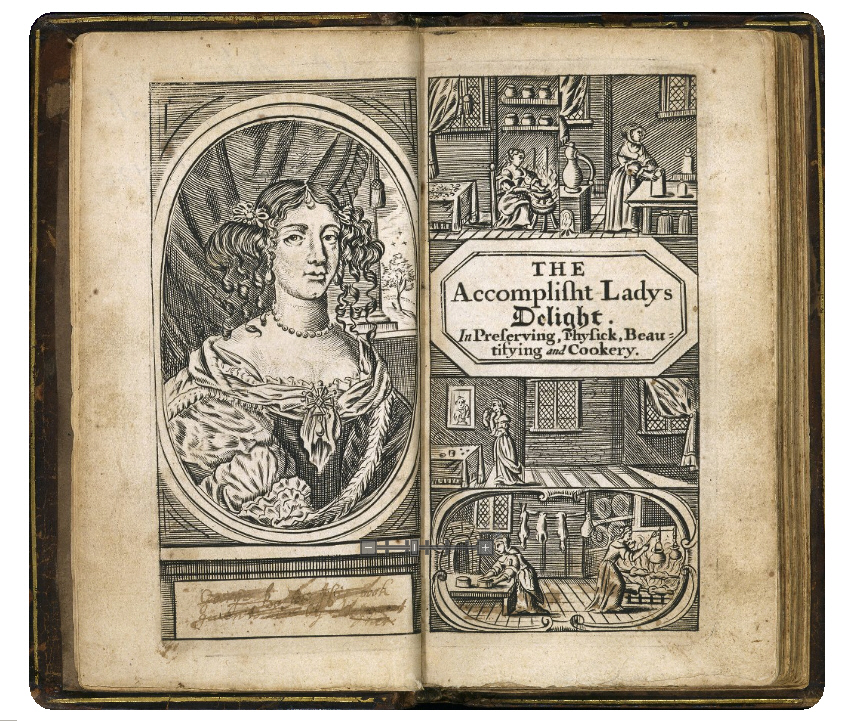
Now, we're all quite used to popping down to the supermarket to pick up a bottle of wine for a Friday or Saturday night, and having a dazzling array of price ranges to choose from. But what options were available for our seventeenth-century ancestors? Hannah Woolley has some ingenious homemade suggestions in The Accomplish'd Lady's Delight.
To Make Artificial Claret:
Take six gallons of water, two gallons of the best Syder, put thereto eight pound of the best Malaga raisins bruised in a Morter, let them stand close covered in a warm place the space of a fortnight, every two days stirring them well together; then press out the Raisins and put the liquor into the sid Vessel again, to which add a quart of the juice of Ras-berries, and a pint of the juice of black Cherries; cover this liquor with bread spread thick with strong Mustard, the Mustardseed being downward, and so let it work by the fire side three or four days, then turn it up and let it stand a week, and then bottle it up, and it will tast as quick as bottle Beer and become a very pleasant drink, and indeed far better and wholsomer then our common Claret (pp. 38-39).
To Make Black-Cherry Wine:
Take a Gallon of the juice of Black-Cherries, keep it in a Vessel close stopped, till it begin to work, then filter it, and an Ounce of Sugar being added to every Pint, and a Gallon of White-Wine, and so keep it close stopped for Use (pp. 81-82).
'To Make Syder:
Take a Peck of Apples and slice them, and boyl them in a Barrel of Water, till the third part be wasted; then cool your water as you do for Wort, and when it is cold, you must pour the water upon three Measures of grown Apples. Then draw sorth the Water at a Tap three or four times a day, for three days together. Then press out the Liquor, and Tun it up; when it hath done working, stop it up close (p. 90).
Unfortunately, Woolley offers no information on alcohol percentages, so it's perhaps best to air on the side of caution when attempting to make these concoctions at home!
References:
Hannah Woolley, The Accomplish'd Lady's Delight (London: B. Harris, 1675), in EEBO.
I thought I'd kick things off today with a topic that has probably been quite close to the hearts (or livers) of all Loughborough English and Drama students and staff in recent days: alcohol. The former, due to celebratory antics as coursework deadlines pass, and the latter, as an aid to all the marking we have inflicted on them!
Now, we're all quite used to popping down to the supermarket to pick up a bottle of wine for a Friday or Saturday night, and having a dazzling array of price ranges to choose from. But what options were available for our seventeenth-century ancestors? Hannah Woolley has some ingenious homemade suggestions in The Accomplish'd Lady's Delight.
To Make Artificial Claret:
Take six gallons of water, two gallons of the best Syder, put thereto eight pound of the best Malaga raisins bruised in a Morter, let them stand close covered in a warm place the space of a fortnight, every two days stirring them well together; then press out the Raisins and put the liquor into the sid Vessel again, to which add a quart of the juice of Ras-berries, and a pint of the juice of black Cherries; cover this liquor with bread spread thick with strong Mustard, the Mustardseed being downward, and so let it work by the fire side three or four days, then turn it up and let it stand a week, and then bottle it up, and it will tast as quick as bottle Beer and become a very pleasant drink, and indeed far better and wholsomer then our common Claret (pp. 38-39).
To Make Black-Cherry Wine:
Take a Gallon of the juice of Black-Cherries, keep it in a Vessel close stopped, till it begin to work, then filter it, and an Ounce of Sugar being added to every Pint, and a Gallon of White-Wine, and so keep it close stopped for Use (pp. 81-82).
'To Make Syder:
Take a Peck of Apples and slice them, and boyl them in a Barrel of Water, till the third part be wasted; then cool your water as you do for Wort, and when it is cold, you must pour the water upon three Measures of grown Apples. Then draw sorth the Water at a Tap three or four times a day, for three days together. Then press out the Liquor, and Tun it up; when it hath done working, stop it up close (p. 90).
Unfortunately, Woolley offers no information on alcohol percentages, so it's perhaps best to air on the side of caution when attempting to make these concoctions at home!
| Image courtesy of foodsofengland.co.uk |
References:
Hannah Woolley, The Accomplish'd Lady's Delight (London: B. Harris, 1675), in EEBO.
Wednesday, 27 November 2013
Psalms in your pocket
First of all, I would just like to apologise for the lack of posts from me over the last 5 weeks or so. As some of you may know, I started my MA this October and unfortunately my deadlines rather got in the way of me being able to blog! Things settle down now for a couple of weeks, though, so I will do my best to make up for it.
This is just a quick post on an App that I happened to hear about via an academic discussion list that I thought some of you might be interested in / amused to hear about. Now, whilst I know that the idea of carrying a Psalm book around in your pocket is by no means a new idea (given the manner in which the book itself was usually published), someone has brought the Bay Psalm Book kicking and screaming into the twenty-first century by making an App!
The App is free to download, and you can either get to a Psalm by selecting your current mood (yes, really!), or you can just shake your iPhone to be given a random Psalm. There is also a short piece on the history of the Bay Psalm Book. I'm by no means suggesting that this is a new scholarly resource, but it is rather fun!
This is the link to the App, although you can just search 'Bay Psalm Book' in the App Store:
https://itunes.apple.com/us/app/baypsalmbook/id733258140
© Jenna Townend 2013
This is just a quick post on an App that I happened to hear about via an academic discussion list that I thought some of you might be interested in / amused to hear about. Now, whilst I know that the idea of carrying a Psalm book around in your pocket is by no means a new idea (given the manner in which the book itself was usually published), someone has brought the Bay Psalm Book kicking and screaming into the twenty-first century by making an App!
The App is free to download, and you can either get to a Psalm by selecting your current mood (yes, really!), or you can just shake your iPhone to be given a random Psalm. There is also a short piece on the history of the Bay Psalm Book. I'm by no means suggesting that this is a new scholarly resource, but it is rather fun!
This is the link to the App, although you can just search 'Bay Psalm Book' in the App Store:
https://itunes.apple.com/us/app/baypsalmbook/id733258140
![]() |
| Photo courtesy of BBC website |
© Jenna Townend 2013
Wednesday, 9 October 2013
Cutting and pasting: 'Mikrokosmographia', anatomy, and the tools of dissection
In just a slight contrast to last week's post on the art of courtship, today I am sharing some wonderful information on seventeenth-century anatomy, dissection and the necessary tools for which to perform the task. The extracts are taken from Helkiah Crooke's text, Mikrokosmographia (1615), who was the physician of James I.
Mikrokosmographia certainly forms part of the increasingly large body of medical texts, with a particular focus on anatomy and dissection, that emerged during the late sixteenth- and early seventeenth- centuries. Anatomy and its study had finally becomes much less of a thorny religious or ethical issue (as it had been during the time that Leonardo Da Vinci was conducting his studies, for example), and had widely become accepted as an important component of medical study and practice. This is certainly evidenced in the following extracts, since Crooke sees it fit to even include meticulous detail about the tools needed to conduct anatomical investigation.
As ever, the text and its later editions can be found on EEBO, and I have preserved the early-modern spelling of the original text.
'Now there is amongest Physitians, a double acceptation of Anatomy; either it signifieth the action which is done with the hande; or the habite of the minde, that is, the most perfect action of the intellect. The first is called practicall Anatomy, the latter Theorical or contemplatiue: the first is gained by experience, the second by reason and discourse: the first wee attaine onely by Section and Inspection, the second by the living voice of a Teacher, or by their learned writings' (D1r).
'We may define anatomy thus: An Artificiall Section of the outward and inward partes. I call it Artificiall to distinguish it from that which is rash and at aduenture which Galen calleth Vulnerary Dissection. For oftentimes in great wounds we obserue the figure, scitua|tion, magnitude, and structure of the outward and inward parts; but that obseruation is but confused, for we cannot distinctly perceiue the branchings of the Nerues, the Serpentine and writhen Meanders of the Veynes, nor the infinite divarications of the Arteries' (D1r).
'This Section cannot artificially bee accomplished, unlesse the Ministers haue convenient Instruments, as are these; Razors of all sortes, great, small, meane, sharpe, blunt, straight, crooked, and edged on both sides; Sheares or Sizers; round and large long Probes of Brasse, Siluer, Lead; a Knife of Box or of Ivory, Pincers of all sorts; hooks, Needels bent rather then straite, Reeds, Quils, Glasse-trunkes or hollow Bugles to blowe up the parts, Threds and strings, Sawes, Bodkins, Augers, Mallets, Wimbles or Trepans, Basons and Sponges; the Figures of all which wee have heereunder delineated, together with a Table whereon to lay the dead, or binde the living Anatomy, with the rings, chains, cords, & perforations fit for that purpose' (D1r).
References:
Helkiah Crooke, Mikrokosmographia: a Description of the Body of Man (London: William Iaggard, 1615), in EEBO.
© Jenna Townend 2013
![]() |
| Taken from the frontispiece of the 1615 edition |
As ever, the text and its later editions can be found on EEBO, and I have preserved the early-modern spelling of the original text.
'Now there is amongest Physitians, a double acceptation of Anatomy; either it signifieth the action which is done with the hande; or the habite of the minde, that is, the most perfect action of the intellect. The first is called practicall Anatomy, the latter Theorical or contemplatiue: the first is gained by experience, the second by reason and discourse: the first wee attaine onely by Section and Inspection, the second by the living voice of a Teacher, or by their learned writings' (D1r).
'We may define anatomy thus: An Artificiall Section of the outward and inward partes. I call it Artificiall to distinguish it from that which is rash and at aduenture which Galen calleth Vulnerary Dissection. For oftentimes in great wounds we obserue the figure, scitua|tion, magnitude, and structure of the outward and inward parts; but that obseruation is but confused, for we cannot distinctly perceiue the branchings of the Nerues, the Serpentine and writhen Meanders of the Veynes, nor the infinite divarications of the Arteries' (D1r).
'This Section cannot artificially bee accomplished, unlesse the Ministers haue convenient Instruments, as are these; Razors of all sortes, great, small, meane, sharpe, blunt, straight, crooked, and edged on both sides; Sheares or Sizers; round and large long Probes of Brasse, Siluer, Lead; a Knife of Box or of Ivory, Pincers of all sorts; hooks, Needels bent rather then straite, Reeds, Quils, Glasse-trunkes or hollow Bugles to blowe up the parts, Threds and strings, Sawes, Bodkins, Augers, Mallets, Wimbles or Trepans, Basons and Sponges; the Figures of all which wee have heereunder delineated, together with a Table whereon to lay the dead, or binde the living Anatomy, with the rings, chains, cords, & perforations fit for that purpose' (D1r).
References:
Helkiah Crooke, Mikrokosmographia: a Description of the Body of Man (London: William Iaggard, 1615), in EEBO.
© Jenna Townend 2013
Wednesday, 2 October 2013
Freshers and 'The Art of Courtship'
It's freshers' fortnight here at Loughborough. I'm not entirely sure where the last year has gone, but here we are again! While things are settling down, and everybody is getting into their new routines, I thought I would share with you this rather lighthearted post.
Inevitably, during freshers' week, one will witness (whether one wants to or not) the blossoming romances in the new intake of first years. (Please note that I use the term 'romance' rather loosely!) Whilst I was doing some research and searches on EEBO in my department this afternoon, I had a moment of serendipity and stumbled across an anonymous work entitled The Art of Courtship, and this got me thinking about how much the idea of 'courtship' has morphed and altered over the centuries. Gone are the days of escorts, suitors, exchanges of letters, sequences of love poems, and in, at least during freshers' fortnight (although even that might be a little optimistic!), are the quick snogs over an alcho-pop in the Students' Union.
Whilst I am certainly not looking back on seventeenth-century courtship with any sort of hazy nostalgia, seeing as there were certainly some pretty binding restrictions on women's conduct, I did think that tonight it would be fun to share with you all a few of my favourite extracts from this wonderful work! The text is essentially a compilation of poems, sequences of letters and short meditations on love and courtship, so below you'll find the three that I have picked out and transcribed.
'Posies' (A7r)
My love shall be,
Forever free,
Naught shall devide,
The knot we've ty'd
By Death alone,
It is undone.
My joy thou art;
Till life is past,
My love shall last,
My love I place
On thy sweet face.
'Tis thou in me,
Shall happy be,
And hast my heart.
From 'The Delights of Marriage' (A8v)
How happy Celia is it, now we are
In wedlock joyn'd and made a happy pair
'Tis true, my Strephon, we have joys,
That few the like can find;
A passion that no time destroys,
Is fix'd in eithers mind
'Loves Power and Cruelty' (A8v)
Lightning is swifter then the glance, of charmin beauty, for 'tho seen by chance it penetrates the Soul, and fires the mind, that wretched Lovers no contentment find; but cruel torments, a tormenting grief, seizes the wretch that's void of a relief.
References:
Anon., The Art of Courtship: or, The School of Delight (London: I. Back, 1686), in EEBO.
© Jenna Townend 2013
Inevitably, during freshers' week, one will witness (whether one wants to or not) the blossoming romances in the new intake of first years. (Please note that I use the term 'romance' rather loosely!) Whilst I was doing some research and searches on EEBO in my department this afternoon, I had a moment of serendipity and stumbled across an anonymous work entitled The Art of Courtship, and this got me thinking about how much the idea of 'courtship' has morphed and altered over the centuries. Gone are the days of escorts, suitors, exchanges of letters, sequences of love poems, and in, at least during freshers' fortnight (although even that might be a little optimistic!), are the quick snogs over an alcho-pop in the Students' Union. Whilst I am certainly not looking back on seventeenth-century courtship with any sort of hazy nostalgia, seeing as there were certainly some pretty binding restrictions on women's conduct, I did think that tonight it would be fun to share with you all a few of my favourite extracts from this wonderful work! The text is essentially a compilation of poems, sequences of letters and short meditations on love and courtship, so below you'll find the three that I have picked out and transcribed.
'Posies' (A7r)
My love shall be,
Forever free,
Naught shall devide,
The knot we've ty'd
By Death alone,
It is undone.
My joy thou art;
Till life is past,
My love shall last,
My love I place
On thy sweet face.
'Tis thou in me,
Shall happy be,
And hast my heart.
From 'The Delights of Marriage' (A8v)
How happy Celia is it, now we are
In wedlock joyn'd and made a happy pair
'Tis true, my Strephon, we have joys,
That few the like can find;
A passion that no time destroys,
Is fix'd in eithers mind
'Loves Power and Cruelty' (A8v)
Lightning is swifter then the glance, of charmin beauty, for 'tho seen by chance it penetrates the Soul, and fires the mind, that wretched Lovers no contentment find; but cruel torments, a tormenting grief, seizes the wretch that's void of a relief.
References:
Anon., The Art of Courtship: or, The School of Delight (London: I. Back, 1686), in EEBO.
© Jenna Townend 2013
Tuesday, 24 September 2013
EEBO-TCP Conference: Digital Methods and Methodologies
As some of my readers may know, last week I attended the 2013 EEBO-TCP conference at Lincoln College, Oxford. It was the first academic conference that I had attended (not counting the ones that I have worked at!), and it really was a fantastic experience. Everybody was so welcoming, and I learnt an awful lot!
Apart from learning an awful lot about digital humanities that, as the old adage goes, I didn't know I didn't know, I also picked up a wealth of useful information that I will be able to use in the coming years. There was news of new and exciting databases that are up and running (what early-modern undergraduate knew that there was a vast electronic world outside EEBO?!), projects that will be completed in the next couple of years, and lots of incredible work that would not have even begun without the use of electronic databases.
Not only that, but the two keynote talks from Dr Jane Winters and Professor Ian Gadd were incredibly interesting. It is thanks to Jane that I am about to start my MA armed with an enormous list of little-known early-modern databases that she has been involved in creating (I will cover some of these in another, separate post soon). And it is thanks to Ian that I will never look at the dog-eared corner of a book in the same way again. In his talk, he pointed out that, in the seventeenth century and earlier, dog-earing the corner of a text was considered the mark of a devout reader: fold over the page that interested you, and you were cementing a very personal and tactile relationship with your book that was unique to you. However, as is ever the case, the significance of this act morphed over the centuries. By the nineteenth century (and up to the present day - just look at the definition of dog-ear in the OED), dog-earing had become the hallmark of a clumsy and careless reader who handled their books too roughly. Really fascinating stuff.
If my little snippets of news from the conference have whet your appetite for all things digital, I would encourage you to go and have a look at the Storify feed from the conference to catch up on all the wonderful goings-on that I haven't covered! It can be found here:
http://storify.com/pipwillcox/early-modern-texts-digital-methods-and-methodologi?utm_content=storify-pingback&utm_source=t.co&utm_campaign=&awesm=sfy.co_fReo&utm_medium=sfy.co-twitter
Below I have just shared a few of my favourite tweets from the conference that were really valuable:
© Jenna Townend 2013
Apart from learning an awful lot about digital humanities that, as the old adage goes, I didn't know I didn't know, I also picked up a wealth of useful information that I will be able to use in the coming years. There was news of new and exciting databases that are up and running (what early-modern undergraduate knew that there was a vast electronic world outside EEBO?!), projects that will be completed in the next couple of years, and lots of incredible work that would not have even begun without the use of electronic databases.
Not only that, but the two keynote talks from Dr Jane Winters and Professor Ian Gadd were incredibly interesting. It is thanks to Jane that I am about to start my MA armed with an enormous list of little-known early-modern databases that she has been involved in creating (I will cover some of these in another, separate post soon). And it is thanks to Ian that I will never look at the dog-eared corner of a book in the same way again. In his talk, he pointed out that, in the seventeenth century and earlier, dog-earing the corner of a text was considered the mark of a devout reader: fold over the page that interested you, and you were cementing a very personal and tactile relationship with your book that was unique to you. However, as is ever the case, the significance of this act morphed over the centuries. By the nineteenth century (and up to the present day - just look at the definition of dog-ear in the OED), dog-earing had become the hallmark of a clumsy and careless reader who handled their books too roughly. Really fascinating stuff.
If my little snippets of news from the conference have whet your appetite for all things digital, I would encourage you to go and have a look at the Storify feed from the conference to catch up on all the wonderful goings-on that I haven't covered! It can be found here:
http://storify.com/pipwillcox/early-modern-texts-digital-methods-and-methodologi?utm_content=storify-pingback&utm_source=t.co&utm_campaign=&awesm=sfy.co_fReo&utm_medium=sfy.co-twitter
Below I have just shared a few of my favourite tweets from the conference that were really valuable:
Monday, 23 September 2013
Roman Relics Part 3: Pompeii
And, finally, we come to possibly the most famous of the three sites that I visited: Pompeii.
I had been to Pompeii once before in 2003 but, I'll be honest, I didn't really appreciate what I was looking at. Yes, I knew it was nearly 2000 years old, but it wasn't until I visited this time that I had that 'WOW' moment where the significance of the site suddenly hit me.
Although Pompeii is, of course, just as busy as many of the central sites in Rome, there were still plenty of moments during the day where you are suddenly and startlingly reminded of the miracle of the city that you are looking at. Nowhere did this hit me more than when I was stood in one of the quiet side streets near the House of the Faun, gazing up the street to the peak of Vesuvius. That night in 79AD must have been genuinely terrifying, and it came to life for me more in that moment than it has in any of the dramatisations that I've watched over the years.
I was trying to find a quotation on which to finish the last of these three blog posts that would sum up the awe-inspiring power of Pompeii and Vesuvius, and found this incredibly moving extract from Statius's Silvae, written in the AD 90s:
I had been to Pompeii once before in 2003 but, I'll be honest, I didn't really appreciate what I was looking at. Yes, I knew it was nearly 2000 years old, but it wasn't until I visited this time that I had that 'WOW' moment where the significance of the site suddenly hit me.
Although Pompeii is, of course, just as busy as many of the central sites in Rome, there were still plenty of moments during the day where you are suddenly and startlingly reminded of the miracle of the city that you are looking at. Nowhere did this hit me more than when I was stood in one of the quiet side streets near the House of the Faun, gazing up the street to the peak of Vesuvius. That night in 79AD must have been genuinely terrifying, and it came to life for me more in that moment than it has in any of the dramatisations that I've watched over the years.
![]() |
| 2000 year old cart tracks running through the streets |
![]() |
| Takeaway food, Pompeii style: storage containers in the counter |
![]() |
| A lion painted onto a wall fresco |
![]() |
| Mythical beast painted onto the same fresco |
![]() |
| The rather extravagant entrance steps to the House of Julia Felix. They were built up over the usual pavement to illustrate her wealth to passersby |
![]() |
| The atrium of the House of Julia Felix (sadly closed to the public currently) |
![]() |
| Another angle on the atrium |
![]() |
| View through one of the house's rooms into the courtyard beyond |
![]() |
| The beautifully preserved black and white mosaic floor |
![]() |
| The mosaic sign on the street outside the House of the Faun. 'Have' means 'greetings' (see also the new header of my personal Twitter page!) |
![]() |
| The ubiquitous 'beware of the dog' mosaic at the House of the Tragic Poet': 'Cave Canem' |
I was trying to find a quotation on which to finish the last of these three blog posts that would sum up the awe-inspiring power of Pompeii and Vesuvius, and found this incredibly moving extract from Statius's Silvae, written in the AD 90s:
'In a future generation, when crops spring up again, when this wasteland regains its green, will men believe that cities and people lie beneath? That in days of old their lands lay closer to the sea? Nor has that fatal summit ceased to threaten' (4.4.78).
© Jenna Townend 2013
Roman Relics Part 2: Ostia Antica
Next stop on my tour of the key Roman sites of Rome and its surrounding countryside was Ostia Antica. This is, without a doubt, my new favourite archaeological site.
Only discovered and excavated in the last century, the site is yet to be over-run by tourists and site-seeing tours. Because of this, the whole area is still virtually totally un-fenced and, although there is a free basic map and a visitor centre, you are still free to go and explore wherever you choose in relative peace and quiet. Provided you have a reasonable working knowledge of the layout of Roman towns (if you don't, all you need to do is watch Mary Beard's 'Meet the Romans'), you can spend, as I did, an entire day wandering around and stumbling across some truly magnificent finds.
If anyone is taking a trip to Rome in the near future, I would definitely recommend Ostia to you. It really is the most incredible place.
© Jenna Townend 2013
Only discovered and excavated in the last century, the site is yet to be over-run by tourists and site-seeing tours. Because of this, the whole area is still virtually totally un-fenced and, although there is a free basic map and a visitor centre, you are still free to go and explore wherever you choose in relative peace and quiet. Provided you have a reasonable working knowledge of the layout of Roman towns (if you don't, all you need to do is watch Mary Beard's 'Meet the Romans'), you can spend, as I did, an entire day wandering around and stumbling across some truly magnificent finds.
If anyone is taking a trip to Rome in the near future, I would definitely recommend Ostia to you. It really is the most incredible place.
![]() |
| Roman takeaways: produce display area in a shop selling hot and cold food just off the forum |
![]() |
| Counter facing out onto the street at this shop |
![]() |
| Part of a beautiful fresco in a private residence |
![]() |
| The street that many of the food shops and stalls face onto |
![]() |
| The infamous 20-seat public latrine! |
![]() |
| Me with the forum in the background |
![]() |
| The entrance to a family's mausoleum, where the urns of both family members and their slaves were kept |
![]() |
| One of the rooms of this mausoleum. Significant family members, such as the husband and wife, would have been placed in the larger alcoves, with children and slaves taking up the smaller alcoves |
| A mosaic advert for a stall dealing in exotic animals. This is in the marketplace that lay behind the ampitheatre (see below) |
![]() |
| The beautiful ampitheatre |
© Jenna Townend 2013
Subscribe to:
Posts (Atom)


.jpg)


.jpg)
.jpg)
.jpg)